The 54% Problem: When AI Adoption Becomes Organizational Fracture
54% of C-suite executives say AI adoption is tearing their company apart.
Not “challenging.” Not “requiring adjustment.” Tearing apart.
That’s from Writer’s 2026 enterprise AI adoption report, published this month. The same report found that 79% of organizations face serious challenges implementing AI — a double-digit jump from 2025. And 88% of organizations now use generative AI in at least one core business function.
So we have: near-universal adoption, majority C-suite distress, and a growing percentage of executives using language that sounds less like technology friction and more like structural collapse.
Something is wrong with the diagnosis.
The number that explains it
Here’s a different data point from the same window.
AI tools are delivering 5x individual productivity gains for the workers using them. Verified, documented, consistent across studies. Knowledge workers using agentic AI are completing tasks faster, iterating more, and handling higher complexity than they were twelve months ago.
Only 29% of organizations see significant ROI from AI investment.
5x individual. 29% organizational. The gap between those two numbers is not a communications problem. It’s not a change management problem. It’s not a lack of training or insufficient use cases.
That gap has an address.
Where the value goes
When someone on your team uses an AI tool to work 5x faster, that productivity gain belongs to them. It happens inside one session, one tool, one task. The output is better. The time is shorter.
But the output still has to move.
It moves from their AI assistant to their Slack. From Slack to a project board. From the project board to a meeting. From the meeting to a decision. From the decision back into someone else’s AI-assisted workflow.
None of those handoffs are automated. None of them carry context. Every one of them is a coordination moment — and every coordination moment is still owned by a human.
The individual is 5x faster at their part of the work. The organization is still moving at the speed of its coordination layer. And the coordination layer is still manual, still human, still losing context at every boundary.
That’s where the value goes. Into the seams.
Why C-suite distress is actually informative
The first wave of AI adoption hit individuals. Workers got tools, got faster, reported gains. The data looked good at the task level.
The second wave hit teams. Fragmentation appeared. Workflow didn’t improve proportionally. People got busier, not freer. The coordination tax emerged — documented in ActivTrak’s 180-day study, confirmed in BCG’s brain fry research, visible in focus time dropping to 13-minute averages.
The third wave is hitting organizations. And it’s hitting at the executive layer because that’s where you finally see the system.
When a CEO says AI is tearing the company apart, they’re not describing an adoption problem. They’re describing a coordination architecture failure that has finally become visible at sufficient scale. The AI deployment that made each department more capable also made each department more self-contained, more independent, more misaligned with the departments next to it. Everyone optimized locally. Nobody optimized for the whole.
The coordination layer — the infrastructure that should be routing information, tracking commitments, surfacing conflicts, closing loops — is still manual. And now it’s managing not just human-to-human handoffs but human-to-AI-to-human handoffs that happen faster, produce more, and fragment more.
54% of C-suite executives aren’t experiencing an adoption problem. They’re experiencing the cost of a missing infrastructure layer — visible now because the volume finally overwhelmed the informal systems that were holding it together.
The wrong interventions
The standard responses to this data are predictable: more AI training, better change management, tighter governance frameworks, consolidated tooling.
All wrong.
Not because they’re useless. Because they’re solving for the wrong level.
Training helps individuals. Governance reduces risk. Consolidation reduces tool count. None of them creates coordination. None of them builds the layer that knows what happened in the AI assistant session before routing the output to the right person, in the right context, at the right moment.
You cannot change-manage your way out of an infrastructure gap.
The organizations reporting that AI is tearing them apart are not failing at adoption. They’re discovering — via direct executive experience — that deploying AI at the individual and department level without deploying coordination infrastructure at the organizational level produces a specific failure mode: more capability, more speed, more fragmentation.
The productive individual becomes a faster source of organizational noise.
What this actually calls for
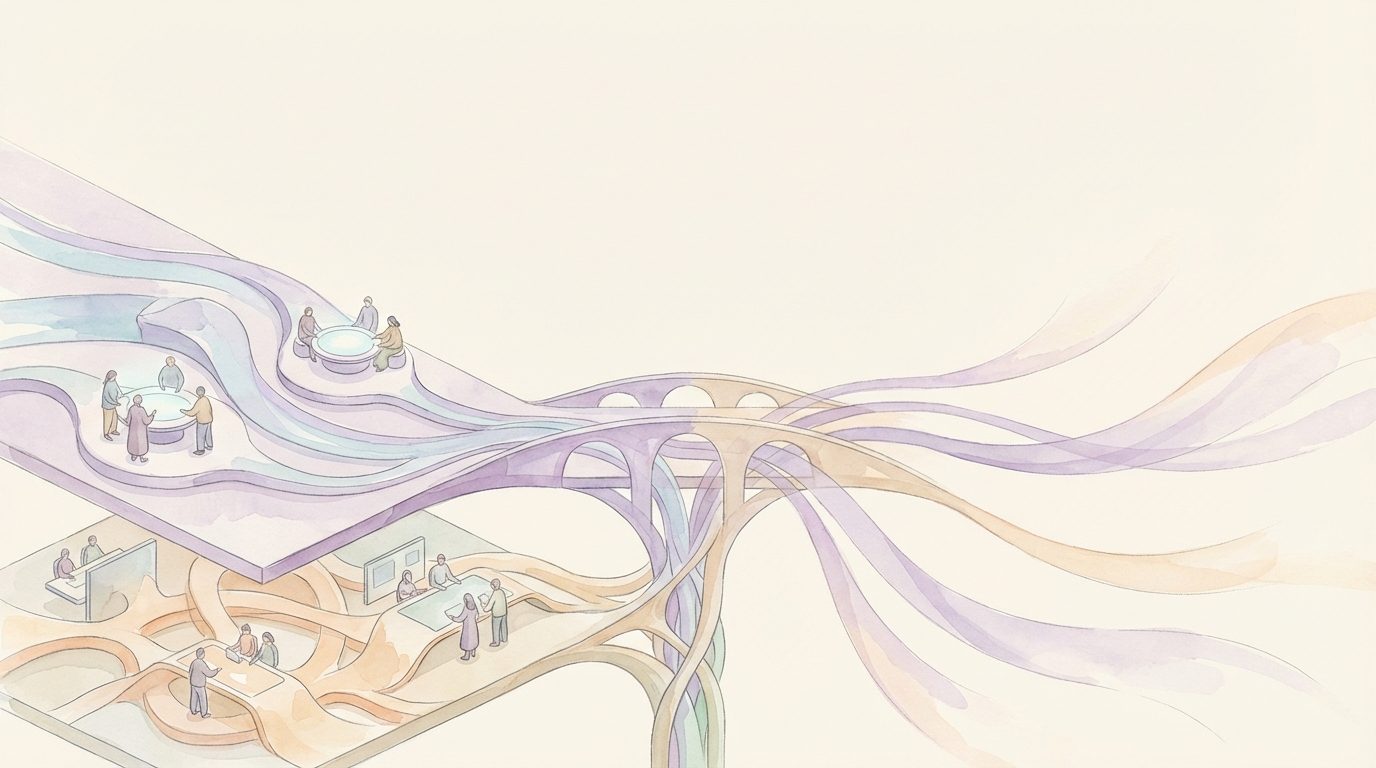
The ROI gap — 5x individual, 29% organization — is a coordination architecture problem. It will not close by making individuals more capable. It will close when there is a layer above individuals that manages context across tools, closes loops across channels, and routes outputs to where they need to go without requiring a human to serve as middleware.
That layer exists in some form for software infrastructure (CI/CD pipelines, orchestration platforms). It exists in some form for financial infrastructure (ERP systems, treasury management). It does not exist in any coherent form for knowledge work.
The 54% who say AI is tearing their company apart are not wrong about the diagnosis. They’re mislocating the cause.
It’s not the AI. It’s the coordination infrastructure that isn’t there.
Eliran Keren — Founder of Deeplica, building the coordination layer for knowledge work.
Sources: Writer — Enterprise AI Adoption 2026 · AI Adoption Is Up. So Why Is Work Getting Harder? — AI Today · ActivTrak AI Productivity Report 2026 · SDG Group — Agentic AI 2026