AI Made You Faster. The Loop Didn't Close.
BCG surveyed 1,488 full-time workers earlier this year.
The finding that made headlines: four or more AI tools, and self-reported productivity crashes. Below baseline. Below where workers were before AI.
Workers managing high AI oversight demands — monitoring, verifying, correcting AI output — reported 14% more mental effort, 12% greater fatigue, 19% more information overload. Among those experiencing “AI brain fry,” 34% showed active intention to quit. That’s compared to 25% among those who didn’t.
The researchers called for output ceilings, block scheduling, structured cognitive breaks. A 60/20/20 rule for allocating time savings. Batching AI prompts into dedicated windows.
They’re not wrong. They’re also missing the actual problem.
The diagnosis everyone is making
The productivity paradox research converges on a common frame: humans have cognitive limits, AI ignores those limits, the solution is to pace AI usage more carefully.
That’s a supervision problem. You have more agents, more outputs to evaluate, more decisions to make about what to accept and what to correct. The throughput is up. The oversight load is up. The human in the middle is getting crushed.
The intervention follows naturally: limit throughput. Build in rest. Redesign workflows so humans aren’t in a constant state of peak cognitive demand.
Reasonable response to a supervisory load problem.
But the productivity paradox isn’t a supervisory load problem. It’s a demand problem.
Why supervision fixes don’t stick
Here’s what the pacing interventions miss. They assume the work itself is fixed, and the only variable is how fast you process it.
That’s not what’s happening.
When AI removes friction from a task, the task completes faster. But in a knowledge work environment, completing a task doesn’t reduce demand — it signals that you have capacity. And a system that can see capacity will fill it.
You process emails faster. More emails arrive, or the expectation of faster response crystallizes. You write reports faster. Scope expands. You ship code faster. Sprint velocity gets recalibrated upward.
Forrester tracked teams that adopted AI writing tools and found output expectations increased 35% within 90 days. GitLab found engineering sprint baselines recalibrated 40% upward within two quarters. The BCG ratchet data shows the same pattern across industries.
The work isn’t fixed. The work expands to fill the capacity you just created.
So when you take cognitive breaks, you’re recovering from a demand load that resets the moment you return. The pacing strategy manages the symptoms of a system that generates unlimited demand — but it doesn’t touch the system.
The thing that’s actually missing
In every AI brain fry case, there’s a common structural gap: no one decided which work should exist.
The AI completed the task. The task was assigned because a request arrived. The request arrived because completing the prior task made you appear available. And at no point did any system ask: should this loop be open at all?
That’s not a throughput problem. It’s an ownership problem. No tool in the stack is responsible for closing the loop that generated the task. Every tool in the stack is responsible for executing tasks faster.
When your entire environment speeds up task completion without managing demand, you don’t get less work. You get a machine that surfaces more of it, faster, than any human can process at sustainable cognitive overhead.
The cure isn’t pacing. The cure is a system that can distinguish between work that moves a priority forward and work that exists because the previous task was resolved quickly.
What this looks like structurally
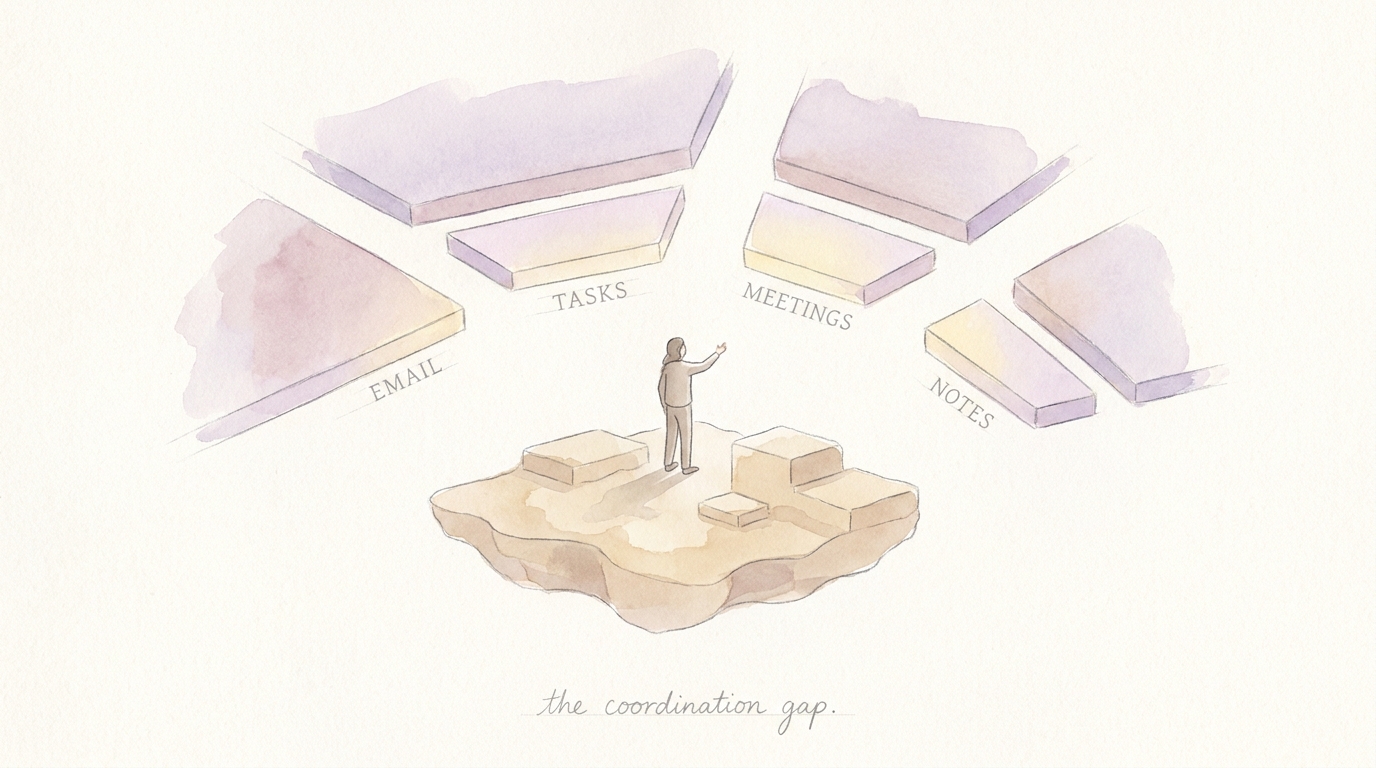
The standard knowledge work stack: communication tools, task managers, AI assistants, project trackers. Each optimized for a slice of the workflow.
None of them coordinate across the whole. None of them hold the state of what’s actually open and what matters. None of them say: this request arrived because you cleared your inbox this morning — it’s not necessarily load you need to carry.
What’s missing is infrastructure at the loop level, not the task level.
Not: “AI completed this task.”
But: “Was this task part of an open commitment? Is that commitment still valid? What’s the status of everything this person actually owns right now — and what shouldn’t exist given current priorities?”
That’s not a feature you bolt onto an existing tool. That’s a coordination layer: a persistent context layer above the tools that tracks commitments, closes loops when they resolve, and surfaces only what genuinely requires human decision.
The workers in the BCG study aren’t exhausted because their tools are too powerful. They’re exhausted because their tools are powerful at task throughput and invisible at demand management.
More throughput into a system with no demand filter is just more input with nowhere to go.
The question the research doesn’t ask
BCG, Berkeley, Fortune — all asking the right question about what’s happening to knowledge workers. None of them asking the structural question.
“How do we pace AI usage better?” is a coping strategy.
“Why does completing work generate more work?” is a systems question.
The answer points to what’s actually missing: infrastructure that closes loops, not just tasks. A coordination layer that tracks what’s open, decides what should stay open, and surfaces only the signal that requires human time.
The workers who thrive in high-AI environments won’t be the ones who pace themselves most carefully. They’ll be the ones whose systems manage demand before it reaches them.
That’s not a mindset shift. That’s a design shift.
Eliran Keren — Founder of Deeplica, building the coordination layer for knowledge work.
Sources: BCG/HBR — When Using AI Leads to Brain Fry · ‘AI brain fry’ is real — Fortune · AI Doesn’t Reduce Work, It Intensifies It — HBR · The AI Productivity Paradox — aimagicx.com