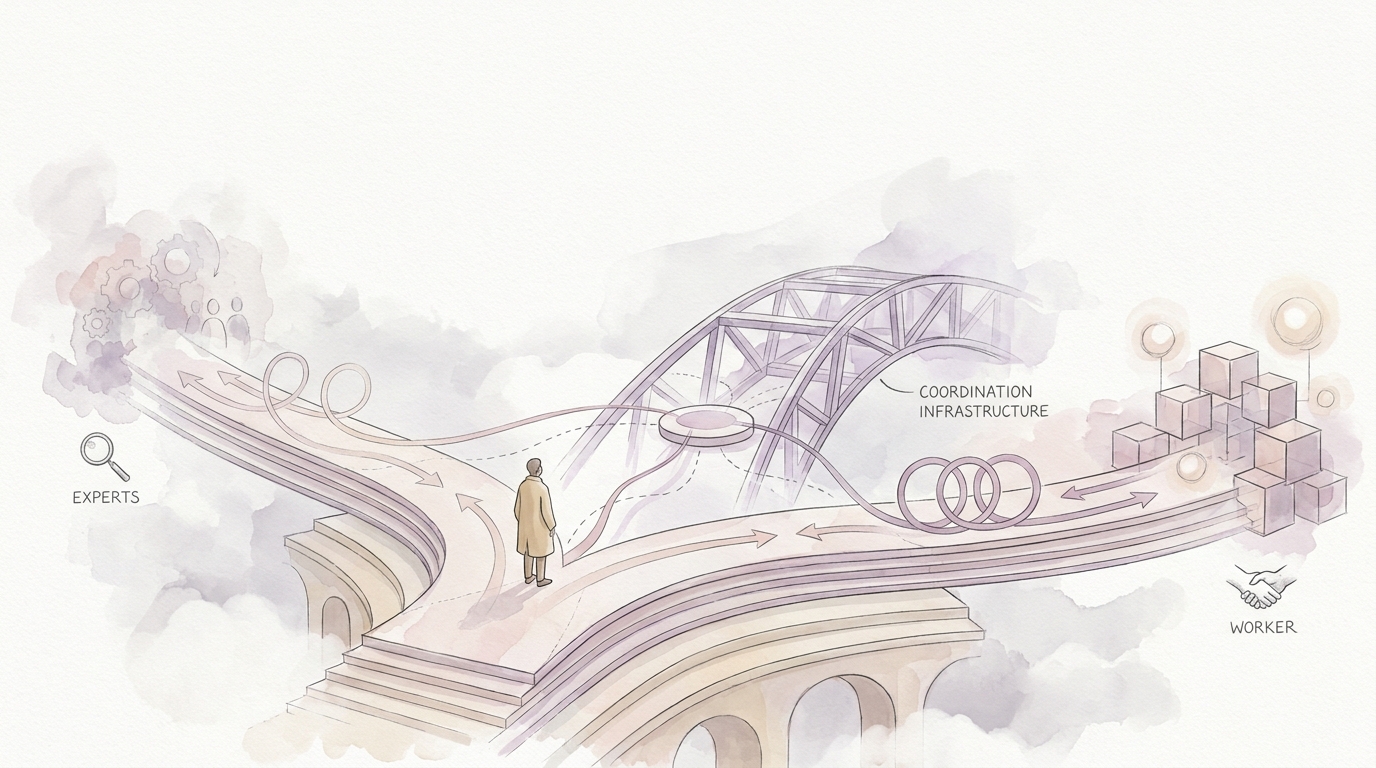
What the Experts Missed
Stanford’s SALT Lab just published a study that’s being misread almost universally.
The scale is serious: 844 occupational tasks, 104 occupations, 1,500 workers across the U.S. workforce, cross-referenced against assessments from 52 AI experts. They introduced something called the Human Agency Scale — five levels, from H1 (no human involvement) to H5 (human involvement essential). Then they asked both groups the same question: for each task, what level of human involvement is appropriate?
The finding everyone is talking about: workers prefer higher levels of human agency than what AI experts deem technologically necessary — on 47.5% of tasks. On 16.4% of tasks, workers want two full levels more human involvement than the experts recommend.
The coverage has been predictable. Workers distrust AI. Adoption will lag capability. Change management is the bottleneck. Get people over the psychological hurdle.
That reading is wrong.
What experts measured
The expert assessment answers a specific question: Can an AI agent complete this task to a sufficient standard?
It’s a capability question. Given the current state of AI, how much of this task can be automated without a human in the loop? The answer is technical. It’s about what the model can produce, how reliably, at what quality threshold.
Experts at this analysis are right about what they measured.
What workers measured
Workers answered a different question — not the one the researchers thought they were asking, and not the one the coverage assumed they were answering.
Workers weren’t assessing AI capability. They were assessing delegation safety.
The implicit question isn’t: Can AI do this? It’s: If I hand this off, what happens to the loop?
That’s not a capability question. It’s a systems question. And it’s the right question to be asking.
The gap the experts didn’t model
When workers say they want H3 — Equal Partnership — across nearly half of all surveyed occupations, they’re not expressing doubt about AI output quality.
They’re expressing something more precise: the absence of a system they can trust to close the loop without them.
Think about what full delegation actually requires. It’s not just confidence that the agent can execute the task. It’s confidence that:
- The agent knows what constraints are currently in play
- The output lands where it’s supposed to
- Someone notices if it doesn’t
- The commitment made by the agent connects to everything else in motion
- The loop closes without the human having to manually verify that it did
Most of those requirements have nothing to do with AI capability. They have everything to do with coordination infrastructure.
Workers aren’t saying: AI can’t do this. They’re saying: I have no way to trust the handoff. And they’re right.
The 45 percent number
The Stanford study also asked about concerns. Forty-five percent of workers cited lack of trust as their primary barrier — not fear of job replacement (23%), not discomfort with the technology itself (16.3%).
Trust.
But trust in what, exactly? The capability of the model? The accuracy of the output?
No. The failure that workers have experienced, over and over, is not that AI produces bad outputs. It’s that AI produces outputs that don’t follow through. The agent sent the message, but nobody confirmed it arrived. The agent drafted the brief, but the version that was submitted was three revisions old. The agent tracked the task, but nobody noticed when the constraint changed and the tracking became wrong.
Workers have learned — through lived experience — that AI execution and outcome accountability are not the same thing. When you hand something to an agent, you can trust the output. You can’t yet trust the system around the output.
That’s not irrationality. That’s pattern recognition.
Why H3 is the correct answer right now
The Stanford study’s dominant finding is that workers prefer H3 — Equal Partnership — in 47 of 104 occupations. Most coverage treats this as a transitional state. Something to be overcome. A preference that will decay as trust builds.
That’s the wrong frame.
H3 is currently the right answer — not because AI can’t perform the task, but because H3 is the only level of autonomy where the human stays close enough to catch coordination failures.
When the agent executes and something misaligns — the context shifted, the commitment was wrong, the output doesn’t fit what actually happened yesterday — H3 workers catch it. They’re still in the loop, still holding context, still able to intercept before the failure propagates.
H1 workers (full AI delegation, no human oversight) can’t catch those failures. They find out afterward. Sometimes much afterward.
The preference for Equal Partnership is workers doing the coordination work that the system doesn’t do for them. It’s not a psychological barrier. It’s a structural response to missing infrastructure.
What changes when coordination is built in
The Stanford researchers noted something that got less coverage than the headline numbers: as AI agents enter the workforce, the key human competencies are shifting from information-processing to interpersonal and organizational skills.
Read that carefully.
The advantage humans retain — the thing that doesn’t get automated even when task execution does — is coordination. Context. Relationships. Understanding what matters and why. The ability to close loops that the agent can’t see.
That’s not a coincidence. That’s the gap naming itself.
What workers are protecting when they prefer H3 is exactly what’s missing from current AI systems: a coordination layer that knows the context, tracks the commitments, and makes sure the output connects to the system it’s operating inside.
When that layer exists, the math changes. You don’t need to stay in the loop to ensure the loop closes. The system closes it. The human can move to H2 or H1 on those tasks — not because they’ve learned to trust AI more, but because the system has earned trust through structure.
That’s the real signal in the Stanford data.
Not that workers are skeptical of AI capability.
That they’re correctly identifying what’s missing before they can safely move out of the loop.
The experts measured what AI can do.
Workers measured whether the system can be trusted to follow through.
Those are different measurements. And workers are asking the more important question.