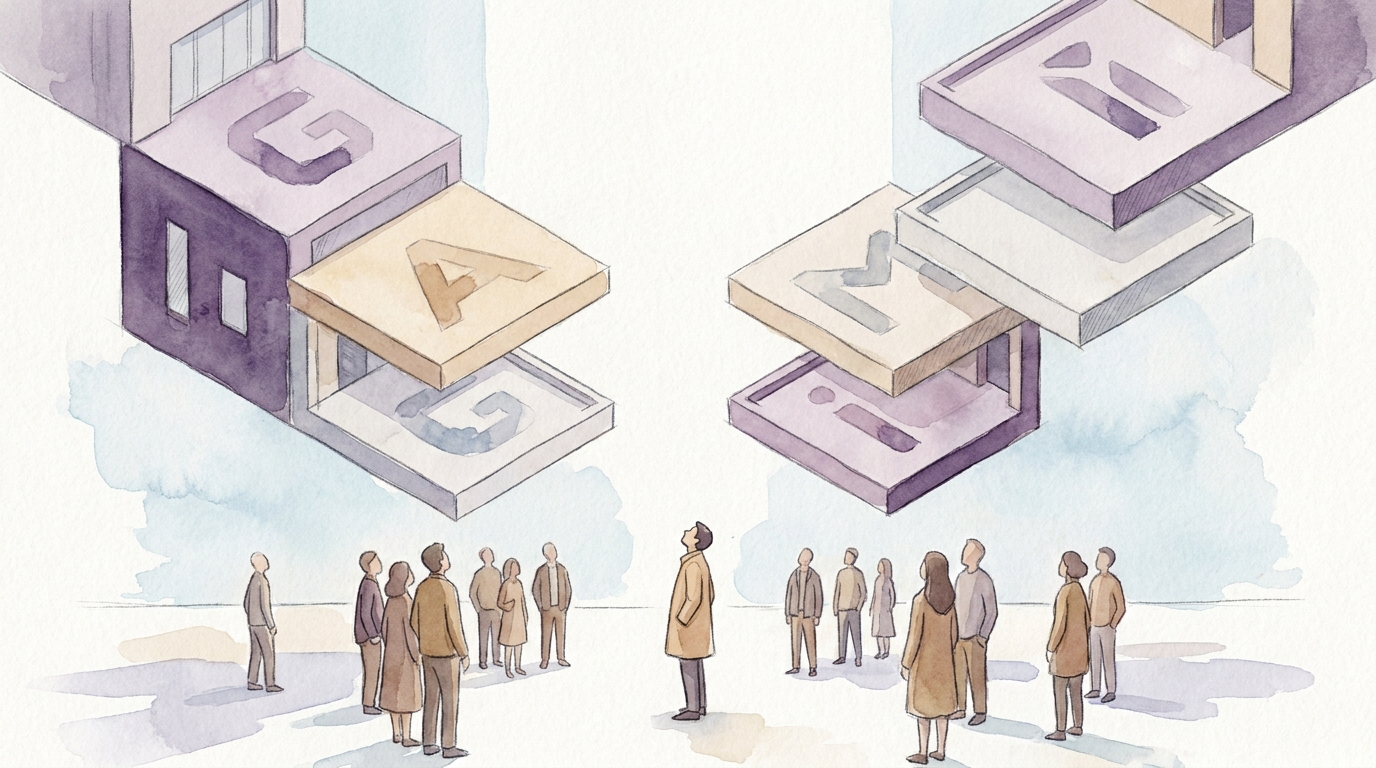
The Execution Layer Is Full
On April 22, OpenAI shipped workspace agents inside ChatGPT.
Shared agents. Cloud-based. They run when you close your laptop. They plug into Slack, Salesforce, and your internal tools. VentureBeat called them “a successor to custom GPTs for enterprises.”
That framing tells you exactly how much the market understands what just happened.
The race that just ended
Take a step back and look at what’s been built over the last eighteen months.
OpenAI has workspace agents. Microsoft has Copilot agents embedded in every Office product. Salesforce has Agentforce. Google has Gemini agents running inside Workspace. Meta built a second brain for 60,000 employees — and a third brain, a shared context layer for teams.
Every major platform in enterprise software now has an agent execution layer. The agents can draft, analyze, retrieve, route, summarize, and coordinate tasks. They run on schedule or on-demand. They persist in the cloud. They don’t need you to prompt them for every step.
The hard part is done. The execution layer exists.
That means the execution layer is now table stakes. Which means the execution layer is no longer the competition.
What VentureBeat missed
OpenAI called workspace agents “a successor to custom GPTs.” That framing is accurate and revealing at the same time.
Custom GPTs failed at meaningful enterprise adoption. Not because they were bad. Because the problem they solved — “I need a custom task executed reliably” — was not the core problem. The core problem is upstream: how does the right task get identified, prioritized, and handed to the right agent at the right moment?
Custom GPTs assumed you would always know what to ask for, always remember to ask for it, and always have the context to know whether the output was useful. Workspace agents are a better version of the same architectural assumption.
They are faster, more capable, better integrated. They run in the background. They share context across a team. They are, genuinely, a real upgrade over what existed before.
But the design is identical at the layer that matters: someone configures what the agent does, then the agent does it.
The question “what should the agent work on today?” is still answered by a human.
The gap the data keeps pointing at
Stanford published their Enterprise AI Playbook in March. Fifty-one successful deployments. The number that defines the space: eleven to fourteen percent of enterprise AI agent pilots reach production at scale.
Eighty-six to eighty-nine percent fail to realize durable value.
The failure modes are consistent: poor integration, unclear auditability, governance gaps, and — the one nobody talks about — “organizations deploying AI agents without the infrastructure to manage them.”
Writer’s 2026 survey found that seventy-nine percent of organizations face adoption challenges despite high investment. The top barrier: unprepared business processes. Not model quality. Not governance. Process.
Process means: nobody knows how to route work to the agent. Nobody knows what the agent should be handling. Nobody knows what the agent committed to yesterday or whether it closed the loop. The agent can execute. The coordination of what to execute still lives in human heads.
This is not a new problem. It’s the same problem, repeated across every platform launch.
What “full” means
When I say the execution layer is full, I don’t mean the technology is finished. The models will keep improving. The integrations will expand. The agents will get faster and more capable.
I mean: the execution layer is no longer a differentiator.
You can build an agent today that drafts your email, prepares your sales call, summarizes your meeting, and responds to your Slack messages. You can build it on ChatGPT workspace agents, on Copilot, on Agentforce, on a hundred platforms that will ship this year with equivalent capability.
The question that was hard in 2024 — can the agent reliably execute this task? — is no longer the question.
The question that is hard now, and will be hard for the next several years, is different:
What does the agent work on? How does it know what matters today versus what can wait? How does it understand the commitments already made, the loops already open, the context already accumulated? How does it tell the difference between a request that should be acted on immediately and one that should be escalated, deferred, or ignored?
These are not capability questions. They are coordination questions.
And no platform has answered them.
The layer nobody’s building
The term “orchestration” has been co-opted by infrastructure vendors to mean multi-agent routing — which agent handles which request, in what sequence, with what handoff protocol. That’s a real engineering problem and they’re right to solve it.
That’s not what I mean.
I mean the layer that sits above orchestration. The layer that understands the person — their priorities, their commitments, their context, the open loops they’re carrying — and decides what the agents should be doing at all.
Call it the coordination layer. Call it the intent layer. The name doesn’t matter.
What matters is that every platform competing for the execution layer is building tools that require it to be filled by a human. The agent does the task. The human holds the context. The agent executes. The human coordinates.
This is why every stat in the enterprise AI space shows the same gap: capable tools, mediocre business outcomes. More agents, less time returned. More execution, more cognitive load.
The agents are executing. The coordination is still manual.
The next competition
OpenAI’s workspace agents will become ubiquitous. So will Microsoft’s, and Salesforce’s, and whoever ships next month with equivalent capability.
The execution layer will get commoditized the way cloud computing got commoditized: fast, predictable, cheap. The technical differentiation will collapse. The advantage will shift upstream.
The companies that build the coordination layer — the system that understands what matters, tracks what’s open, surfaces what the agent should work on, and closes loops without the human having to hold them — will own the next decade.
Nobody has built that yet.
The race just opened up.
Deeplica is building the coordination layer. The layer above agents. Not another execution tool.